
Understanding How Supplements Work
This section is the science underneath everything else. You do not have to read it first: browse it now if you are curious, or come back to it when an entry uses a word you want explained. It opens with how I think about supplements and herbs at all, and the five rules I follow with my own: consider tapering as you feel better, consider carefully adjusting selected supplements if symptoms arise, check your liver enzymes, stay in close coordination with your team, and monitor how you actually feel. Then a little biology, and how to read the chemical drawings that appear beside the entries. Then the loop that keeps IBD turning: a disturbed microbiome provokes inflammation, inflammation loosens the barrier, a loosened barrier disturbs the microbiome further, and the disease runs as a cycle rather than a straight line. Then the five things a supplement can do inside that loop. Those five mechanisms are not the same as the Five in Section A; the Five are products, the mechanisms are jobs, and one product can do more than one job. The cytokines get a glossary of their own, because eight names come up on almost every page and it helps to know them as characters. Finally the gut wall itself, drawn in cross-section with every highlighted entry placed where it acts. The point of all of it is simple: when you and your team talk about a regimen, you should be able to say in one sentence what each bottle is for.
Why supplements at all? A philosophy
Before the mechanisms, the mindset. Here is how I think about supplements and herbs after a decade of taking them, studying them and watching them work and fall short in other people. What follows is my own interpretation of that experience, not a consensus.
They come third, and I mean it
Almost everything in this guide can be had, at least in part, from food. Turmeric and ginger in cooking, quercetin in red onions and capers, anthocyanins in a bowl of frozen blueberries, glycine and collagen in a pot of bone broth, butyrate from the fiber your own bacteria ferment, vitamin D from a walk in the sun. A dietary strategy is not the warm-up for a supplement plan; it is the plan, and a bottle is what you add when food and life cannot get you all the way there. One caution: the amount of a compound in a food and the amount used in a supplement trial are not automatically interchangeable, and the entries say which is which.
And yet: sometimes they are the deciding force
Here is what has changed my mind over the last few years. When a good medical strategy is in place, and a good dietary strategy is in place, I have watched supplements and herbs become the difference between remission and flaring. Not occasionally, and not only in people avoiding medication; in people on biologics and small molecules too. Something as unglamorous as a phytosome curcumin, a quercetin complex and a decent vitamin D level can be the margin that keeps a person on the right side of the line. That is why this guide exists, and why it takes the products so seriously.
Diversity beats intensity
IBD is not one signal; it is a crowd of them, TNF-α, IL-6, IL-1β, IL-17, IL-23, interferon-γ, leukotrienes, oxidative stress, and behind them a leaky wall and a disturbed microbiome. A biologic is a precision instrument aimed at one of those signals. Supplements and herbs are the opposite kind of tool: individually gentle, but between them they lean on many cytokines and many parts of the wall at once. The next page makes that argument in one picture, and this section ends with the gut wall drawn in cross-section so you can see where each entry lands.
Five rules I follow with my own
- Consider tapering as you feel better. A regimen built for a flare is not a regimen for remission. When things are calm, I lower doses and drop what I no longer need, with my team's knowledge; some weeks, on a rest day, I take nothing at all. A body that runs well on less is the goal.
- Consider carefully adjusting selected supplements if symptoms arise. At the first signs of trouble I adjust a few chosen doses (quercetin, curcumin, glutamine, bovine immunoglobulins) alongside, never instead of, the medical plan my team and I have agreed. A supplement can also make someone feel worse, and stopping it is an adjustment too. Which ones, and how far, is what "My personal protocol" in Section N is for; nothing here is an instruction to escalate on your own during a flare.
- Check your liver enzymes. Herbs are metabolized by the same liver that handles your medications. Anyone taking several of them should have liver enzymes (ALT, AST, ALP, bilirubin) on their regular bloodwork, and should know what the numbers mean. A rising enzyme is a reason to stop and talk, not to push through.
- Stay in close coordination with your team. Your gastroenterologist, your GP, your integrative practitioner, your dietitian, your coach: they should all know the full list, with doses. Bring the tracking sheet from Section N. A table is harder to dismiss than a bag of bottles, and it lets your team catch the interaction you did not know about.
- Monitor how you actually feel. Bowel movements, energy, sleep, pain, mood, and the labs that measure inflammation (CRP, fecal calprotectin). Add one thing at a time and write down what changes. The trials in this guide were designed one variable at a time; copy the design and you will learn what each bottle is really doing for you.

Diversity beats intensity
The whole argument for supplements and herbs in IBD, in one picture. A biologic is a precision instrument aimed at a single signal. A regimen is a crowd of gentle hands on many different levers at once.
 View full illustration ↗
IBD is not one signal. It is a crowd of them: TNF-alpha, IL-6, IL-1 beta, IL-17, IL-12 and IL-23, interferon gamma, the leukotrienes, oxidative stress, a barrier that leaks, a microbiome that has lost its calmest members. The great medications of the last twenty-five years work by choosing one member of that crowd and silencing it completely. Infliximab and adalimumab take TNF-alpha out of the room; ustekinumab takes IL-12 and IL-23; the JAK inhibitors cut the wire several cytokines share. That precision is their power, and it is also their limit: when a person's disease is being driven by a different member of the crowd, the drug that works so well for the next patient does nothing for them.
Supplements and herbs are the opposite kind of tool. Individually they are gentle; no polyphenol lowers TNF-alpha the way an antibody does. But a well-built regimen leans on many cytokines and many parts of the wall at the same time, and it can reach the levers no drug has been built for: the mucus layer, the tight junctions, the fuel supply of the colonocyte, the species that are missing from the microbiome.
This is why the mechanism tags on every entry matter, and why the capability matrix in Section N exists. When you build a regimen, choose entries that land in different places: something for inflammation, something for the barrier, something that feeds the microbiome, something that replaces what the disease has drained. Three anti-inflammatories that all act on NF-kappa B are less useful than one anti-inflammatory, one barrier repairer and one fiber.
It is also why this guide never asks you to choose between the two kinds of tool. The biologic buys time and quiet; the regimen works on the ground the biologic cannot reach. Most of the people I have watched do well over years are using both, with their medical team knowing exactly what is in the cabinet.
Where each entry lands
This section closes with the gut wall drawn in cross-section, "Where each mechanism lands," with every highlighted entry placed where it acts. "Meet the cytokines," a few pages on, names the crowd.
A little biology: from molecules to your gut
The entries in this guide talk about atoms, molecules, proteins, cells and microbes, and most of them carry a chemical drawing. Here is the background in pictures: how the scales fit together, and how to read the drawings.

Zooming out. These four views move up in scale; they are not a chain of chemical reactions. Atoms are the alphabet of the drawings: carbon, hydrogen, oxygen and nitrogen make up almost everything in this guide. Small molecules such as butyrate, glutamine and quercetin are short words in that alphabet. Proteins are very large molecules, and a membrane is an assembly built from lipids. Gut-lining cells sit in a single sheet with microbes living in the mucus just above them, and the intestines are those cells and their neighbors working together as tissue. A supplement may contain one molecule, a protein, a living organism or a mixture; the entries say which. Recognizing a structure tells you what a compound is, not whether it helps.
How to read a chemical structure
Example: butyric acid. This is the neutral acid drawn in the guide's butyrate entry (F-02): C4H8O2, PubChem CID 264. The left panel is the drawing as it appears on the cards; the right panel is the same molecule with the hidden letters written in.
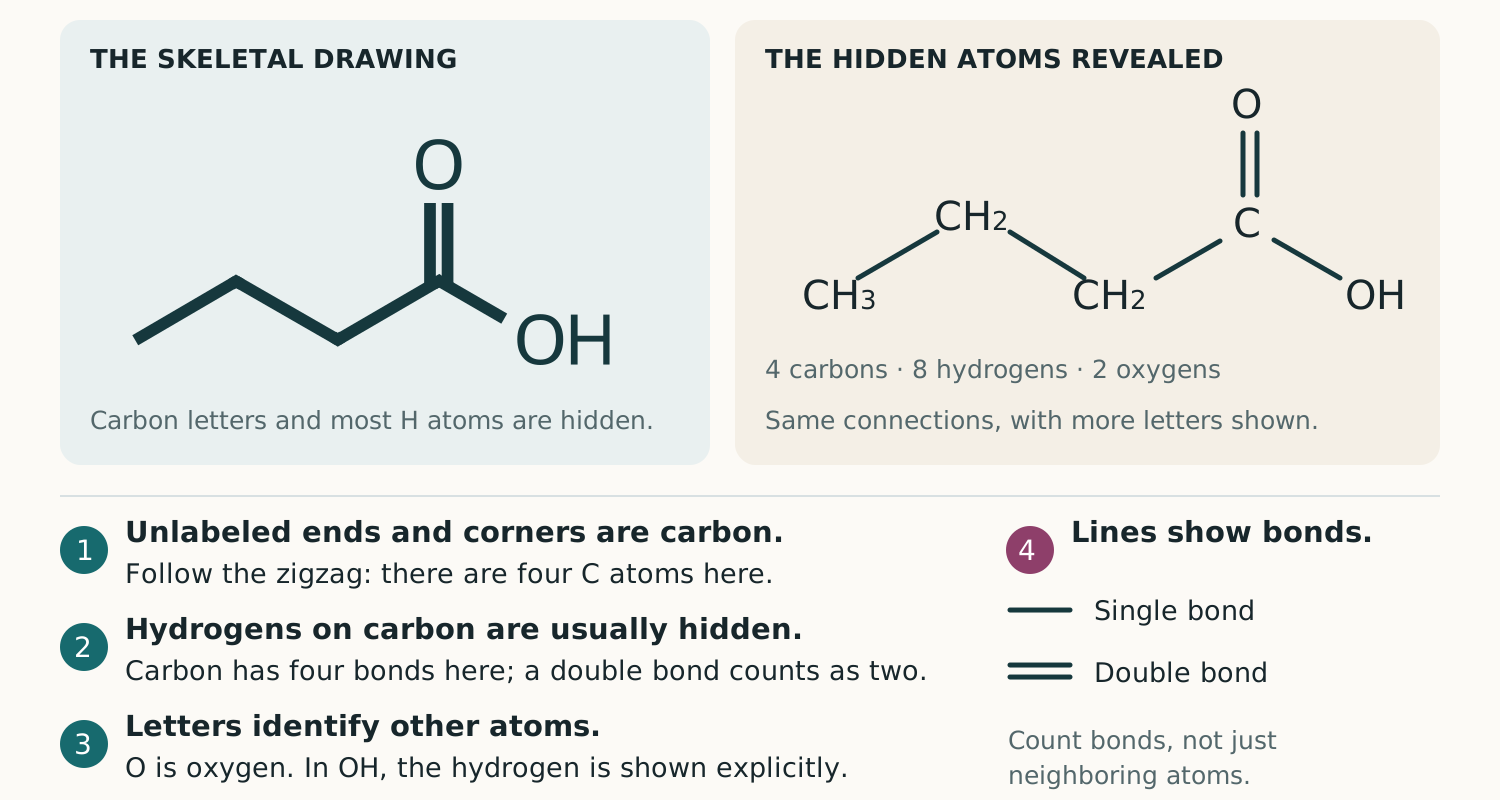
Chemical drawings use a compact visual language. An unlabeled end or corner of a line is a carbon atom. The hydrogens attached to carbon are usually left out, because in these ordinary neutral molecules carbon always has four bonds and you can fill them in yourself; a double bond counts as two. Other atoms are written as letters, O for oxygen and N for nitrogen, and an OH shows its hydrogen explicitly. One line is a single bond, two lines a double bond. Once you can read butyric acid, you can read every structure in this guide; the larger ones are only more of the same letters.
Butyric acid and butyrate. The drawing shows the acid. Butyrate is its related ion: the acid group has O− in place of OH, and the minus sign marks an electrical charge. Sodium butyrate, the form in many products, adds a sodium ion to balance it. In the near-neutral conditions of the colon, butyric acid mostly exists as butyrate, which is why the two names are used almost interchangeably in this guide. The fuel page in Section A draws the ion; the F-02 card draws the acid; both are correct, and the caption on each says which.
Structure: the guide's F-02 drawing, verified against PubChem CID 264. Drawing conventions follow the IUPAC recommendations for skeletal formulas.
The loop that keeps IBD turning
Whatever your diagnosis, the disease runs as a cycle with three parts, and every supplement in this guide works by leaning on one of them.
 View full illustration ↗
IBD runs as a loop. The immune system in the gut wall over-reacts. The microbiome has lost the species that keep it calm. The barrier of mucus and cells has become leaky, so more bacterial material reaches the immune system, and the loop turns again. A supplement helps by interrupting that loop somewhere, or by replacing what the disease has drained. The point of drawing it is to intervene in it rather than watch it, and every section that follows is a place to do so. The loop is the same in Crohn's, ulcerative, indeterminate and microscopic colitis; what differs is where in the wall it runs and which part dominates.
Dysbiosis is the microbiome losing the species that keep it calm and gaining the ones that provoke. Inflammation is the immune response in the wall, the part the medications act on. Permeability is the barrier letting through what it should hold back, which feeds the immune system more microbial signal. The arrows run one way on the page, but in the gut every part drives every other. That is why a single-mechanism regimen disappoints, and it is the one idea to carry into any conversation about a regimen: know which part of the loop each bottle is for.
Five things a supplement can do in IBD
Every one of the hundred entries is tagged with one primary mechanism from this list, plus any secondary ones. Learn these five and the rest of the guide organizes itself.
 View full illustration ↗
Two things follow. First, no single supplement addresses all five mechanisms, which is why a regimen built around one "miracle" ingredient disappoints. Second, nourishing the microbiome matters more than modulating it: killing what is overgrown is a shorter-term move than feeding what is missing. The 100 × 5 capability matrix in Section N shows every entry against every mechanism on two pages. It is the page to photograph.
The first four are the four places you can interrupt the loop on the previous page: quiet the inflammation, feed the microbiome, thin what has overgrown, rebuild the wall. The fifth, repletion, is not a mechanism in the gut wall at all; it is the floor the other four stand on, and it is guided by lab tests rather than trials. Five mechanisms does not mean five products. Most people cover the ones that matter to them with two to four bottles, and knowing the categories is what lets you and your team see which job, if any, is uncovered.
Read the tags as verbs, and judge each entry by the measure its verb implies. An entry tagged Inflammation asks to be judged by CRP and fecal calprotectin over months, not by how the week felt; one tagged Nourish by tolerance and stool over weeks; one tagged Barrier by how the wall behaves under load; one tagged Replenish by a lab value and nothing else. Curcumin carries Inflammation first and Barrier and Nourish second, which is part of why it sits in the Five. Berberine is Modulate first, and its place in Section E rather than Section C tells you how to use it.
When you build a regimen, cover the mechanisms before you cover the entries. Three anti-inflammatories that all switch off NF-κB are one move made three times; one anti-inflammatory, one fiber and one barrier repairer are three moves. The tags on every card are the shorthand, the section letters are the long form, and the matrix at the back is the whole board at once. If a regimen is not working, look for the mechanism nobody is covering before you add a fourth bottle to the one everybody is.
Meet the cytokines
Eight names come up on almost every page of this guide. Here they are as characters, because that is how I remember them: the brute, the spark, the amplifier, the twins, the darter, the watcher, and the two switches that turn the whole cast on and off.
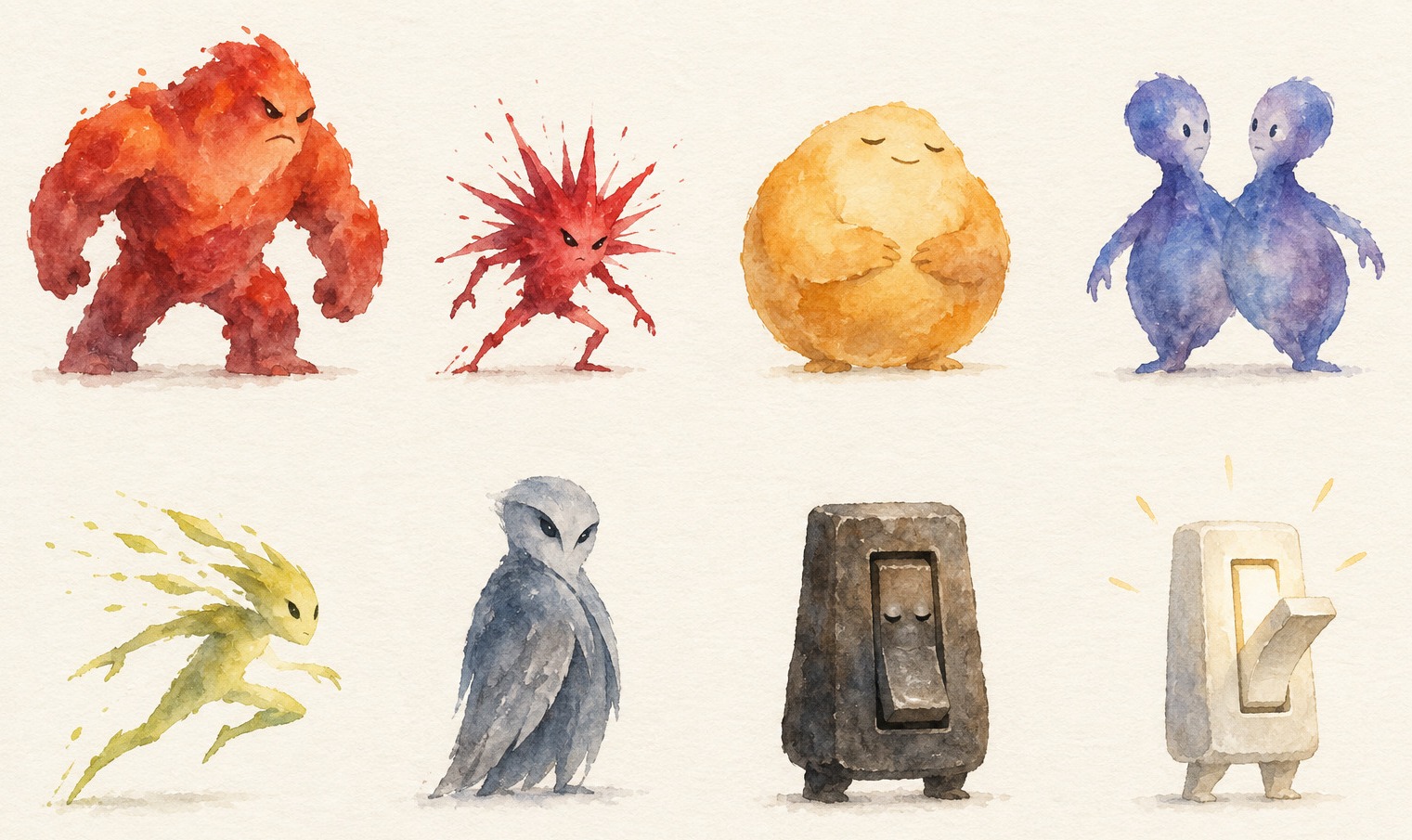
Tumor necrosis factor alpha is the loudest inflammatory signal in IBD: it recruits immune cells, opens tight junctions and drives the tissue damage you see on a colonoscopy.
Interleukin-1 beta is the alarm that sets other cytokines off. It is released when the innate immune system meets bacterial material crossing the wall.
Interleukin-6 turns local inflammation into a systemic state: fever, fatigue, the raised CRP on your blood test, and the flat mood of a flare.
Two related messengers that steer naive T cells toward the aggressive Th1 and Th17 programs that keep Crohn's and UC turning.
Interleukin-17 recruits neutrophils and defends the wall against fungi and bacteria. It is inflammatory, and it is also protective: blocking it made Crohn's worse in a trial.
Interferon gamma is the Th1 signal that activates macrophages and, in the gut wall, damages the epithelium directly.
Not a cytokine but the transcription factor that switches most of them on. Nearly every anti-inflammatory polyphenol in this guide works partly by keeping this switch off.
The transcription factor that turns on the cell's own antioxidant and repair machinery: glutathione synthesis, detox enzymes, the resolution of inflammation.
The medications are named so you can see where the biologics and small molecules act; nothing here is a suggestion to change one. The entries named are the ones whose trials or mechanism studies touch that signal; the full picture for any entry is on its own page.
The good guys
Not every cytokine is a villain. Three of them keep the peace, tend the soil and rebuild the wall, and a surprising number of the entries in this guide work by helping them rather than by fighting the others.

Interleukin-10 is the signal that tells the immune system to stand down. It suppresses TNF-α, IL-1β and IL-6, calms macrophages and keeps regulatory T cells in charge. Children born without a working IL-10 pathway develop severe, very early IBD, which is the clearest proof there is of what it does.
Transforming growth factor beta plants tolerance: it steers T cells toward the regulatory kind and drives the repair of tissue after injury. It has a dark side, laying down scar tissue and stricture when it runs too long.
Interleukin-22 speaks to the epithelium itself: it tells the wall to proliferate, to make antimicrobial peptides, and the goblet cells to make more mucus. It is one of the few cytokines whose job is mostly to rebuild.
The lesson of this spread: "lower every cytokine" is the wrong goal. Blocking IL-17 made Crohn's worse in a trial; a gut with no IL-10 is a gut with severe disease from infancy. The supplements and herbs that help most tend to shift the balance toward these three rather than silencing the crowd on the previous page.
How the cytokines interact

The glossary's cast returns in one simplified scene at the gut wall. Bacterial material crossing a loosened barrier wakes NF-κB, the dark switch, which releases TNF-α, IL-1β and IL-6; the red arrows show that inflammatory signaling reaching back up to the epithelium and opening it further, so more material crosses and the loop turns. To the right, IL-12 and IL-23 steer T cells toward IL-17 and IFN-γ. To the left, IL-10 tells the crowd to stand down, TGF-β plants tolerance and IL-22 tells the wall to rebuild. NF-κB and Nrf2 are transcription factors, drawn as switches, not cytokines. The ingredients around the edge are examples from this guide placed near the part of the picture their studies touch; fiber-containing foods sit above the wall with butyrate drawn separately, because your bacteria make butyrate from fiber. Icons and connectors are teaching metaphors, not a complete pathway, and none of them is evidence that a product works.
Where each mechanism lands
The cross-section from the opener of this section, now labeled: the lumen and its bacteria above, the mucus layer, the single-cell-thick epithelium sealed by tight junctions, and the immune tissue beneath. Seventeen markers show where entries in this guide actually act; everything in the nine sections is a variation on one of these moves.

How to read the rest of this guide
One hundred entries in nine sections, two numbers on every entry, a product for almost all of them, and the reference sections behind them. Here is the map.
The 100
After the Five come four sections organized by what a supplement does in the gut, Anti-Inflammatories, Microbiome Nourishing, Microbiome Modulating, Barrier Repair, and four organized by what it is: Peptides, Digestive Support, Amino Acids, Vitamins & Minerals. Within each section, the entries I'd actually buy get a full product highlight card: photo, brand, link, a short brief, both scores. Every other entry is in the section's list, linked where a clean product exists.
Who this is for
Written for people with IBD first, but also for the clinicians who care for them: gastroenterologists, GPs, integrative practitioners, dietitians and health coaches. Patients will find the products and plain-language briefs; clinicians will find the study tables, doses as studied, and interaction notes. It is for everyone in the room.
Two numbers on every entry
A display number (1–100, its position in this edition) and a stable ID like C-08 that never changes. Talk about entries by ID; the display numbers will shift as editions change.
Two scores on every entry
The evidence score is about human IBD data specifically, on the fixed scale at right. Andrew's score is my own judgment, 1–5, what I've seen work over a decade in the IBD community, labeled as opinion, never blended into the evidence. Where the two disagree you'll see it. Generally my score runs a little higher than the evidence. That is a reflection of the field: research on supplements is not well funded, and there is far less of it than there is on the efficacy of medications, so a low evidence score often means "not yet studied" rather than "studied and failed." A dash in my score means I have not formed a personal opinion about that entry yet. It is not a zero, not a rejection, and not an evidence score. The vitamins and minerals in Section J carry a dash for a different reason: when a nutrient is being replaced because a lab test says it is low, my opinion does not belong in the decision.
Doses
Reported as used in the studies, never as a suggestion for you. Where I mention what I personally take, it is labeled as exactly that, and it is not a dose for anyone else.
The evidence scale
A 1 is not a reason to leave something out. Preclinical evidence is legitimate; a low score is information, not a verdict. Quercetin (A-02) is the case that shaped the wording of the 2: two large cohorts link dietary quercetin to better outcomes in IBD, and no one has yet trialed the supplement.
What comes after the 100
Buying Well (Section K) is about labels, additives and how the dispensary works. Beyond the Hundred (L) holds the honorable mentions I am still exploring, the things people ask about that didn't make the cut, and a note on enemas. Then a bonus section (M) on sleep, stress and attention, five products that are not IBD supplements but that I have come to think of as part of the picture. And Building Your Regimen (N) closes the guide: how to stack and sequence, interactions with IBD medications, the four questions, my own protocol and why, and the capability matrix.
The links, and how I choose brands
Every product link in this guide is a short link of the form go.supplementsforibd.com/<product>. Each routes to that exact product in my Fullscript dispensary. I earn a commission; you pay Fullscript's price. US shipping only. I choose products one at a time, not brands wholesale: recommending Microbiome Labs' bovine immunoglobulins is not a recommendation of the same company's spore probiotic, which I advise against. Companies get bought and formulas change, so I keep checking, and the newest edition of this guide is the one to trust. Section K explains the vetting in full; if you prefer another well-tested brand of the same ingredient, that is a reasonable choice.
Four diseases, one guide
"IBD" is four diagnoses, not two, and this guide is written for all of them. Where an entry's evidence comes from one disease and not another, the entry says so.
 View full illustration ↗
If your diagnosis is microscopic colitis, read this before anything else
The evidence bars in this guide were earned in Crohn's and ulcerative colitis, and they do not transfer automatically. Mesalamine, a mainstay of UC, is not recommended over budesonide in MC by the AGA. Exactly one entry has been tested in your disease: Boswellia (C-02), in a small placebo-controlled trial in collagenous colitis, produced remission in 64% versus 27% per protocol, a result that did not hold on intention-to-treat analysis. Everything else here is plausible on mechanism and untested in MC, and the entries say so where it matters.
Two things belong to your gastroenterologist rather than to this guide, and I mention them only so you know to ask. Budesonide is first-line treatment, it works well, and nothing in these pages replaces it. And microscopic colitis can be triggered by common medications, PPIs, NSAIDs and SSRIs among them, and travels with celiac disease and bile-acid malabsorption; a medication review and a celiac screen are worth requesting if they haven't happened.
Where I would still start: the Five, for the same reasons they lead the guide, safe, broad and mechanism-based, with the honest caveat that in MC they are untested rather than proven. Then A-04, because binding luminal antigen and firming stool fits a watery-diarrhea disease better than most entries. Then A-05, because budesonide is a corticosteroid and bone protection matters in a population that skews older. Then C-02. The probiotics in Section D are the one group I would hold back on: the AGA suggests against them for inducing remission in MC. (refs 173–176)
Diet first. Medicine when it's needed. Then this.
Supplements don't work on top of a diet that's feeding the fire, and they are not a substitute for a good gastroenterologist. Both of those sentences are load-bearing.
Diet is the foundation
There is no one diet for IBD. There is, however, no version of this disease in which diet doesn't matter, it is the foundation everything else in this guide sits on, and it is the thing I would work on before I bought a single bottle. Several dietary approaches have been successfully modified to work in IBD, and I've watched each of them change lives:
- The Specific Carbohydrate Diet (SCD), the grandparent of IBD diets, with a growing trial base in pediatric Crohn's.
- The IBD Anti-Inflammatory Diet (IBD-AID), developed at the University of Massachusetts, a phased, whole-food, prebiotic-rich approach built specifically for this disease.
- Paleo AIP, modified, the autoimmune protocol, adapted for the realities of a sore gut.
- The Mediterranean diet, the pattern with the broadest general-health evidence, and a randomized trial in Crohn's disease in which it performed comparably to the Specific Carbohydrate Diet. (ref 209)
The best single resource I know for going deeper is Nutritional Therapy for IBD (ntforibd.org), a nonprofit that does this one thing well. A companion diet document is planned; the newest version of this guide at supplementsforibd.com will link to it when it exists.
The order of operations
A medical team you trust first, with medication when the disease needs it. Then diet, mindset and the rest of the foundation. Then supplements, one at a time, on that stable foundation, so you can tell what each one is doing. Started in that order, supplements do real work. Started out of order, they mostly disappoint.

On medicine, and on your gastroenterologist
I want to be unambiguous about this, because a guide full of herbs can be read the wrong way. I strongly support working with a good gastroenterologist, and using medication when it is deemed necessary. Untreated inflammation in IBD is silently destructive; feeling better is not the same as being better, and only your team can tell the difference with scopes, imaging and labs.
I think of medicines the way I think of the supplements in this guide: as tools that can help the body heal. Biologics, immunomodulators, mesalamine, a course of steroids to break a flare, these have saved bowel and saved lives, and there is no shame and no failure in needing them. Many people in remission on medication use supplements alongside them, with their team's knowledge, and that is a perfectly good place to be.
And a caution that runs the other way: supplements and herbs are not automatically safer than prescription drugs. "Natural" is not a safety category. Several entries in this guide interact with IBD medications (the interaction tables say so) and a few have real toxicity at high doses. Treat them with the same respect you'd give a prescription: know the dose, know the interactions, tell your team what you take.
One more thing your team will agree with me on: be very careful with NSAIDs. Ibuprofen, naproxen and aspirin at pain-relief doses damage the gut lining directly; researchers use high-dose NSAIDs to induce colitis in animal models, and in people they are a well-recognized flare trigger. A headache is not worth a flare. Ask your team what to reach for instead.
Bring this guide to your GI
Print the section on any supplement you're considering and bring it in. A gastroenterologist who has never heard of half these compounds can still read a study table with doses on it, and a table is much harder to dismiss than a bottle.
About me, and why I wrote this
I'm Andrew Kornfeld. I have Crohn's disease, I have been in remission since 2014, and I have spent nine years working with people who have IBD. This guide is the thing I have been meaning to make for most of that time: the supplements and herbs I actually believe in, with the evidence and the exact products, in front of the people who need them. I never found a comprehensive source on supplements and IBD, so I built one.

I was diagnosed in high school, and for a long time I did what most people with Crohn's do: I took the medications, I got by, and I never quite felt well. What changed things was learning to treat my body as a system, one where the medical plan, what I eat, how I move, how I sleep, how I handle stress, and yes, what supplements and herbs I take, all have interconnected effects on my Crohn's disease at the same time. Everything I take acts on the scientifically established mechanisms of IBD, and Section B is that idea drawn out. I studied neuroscience and psychology at UC Santa Cruz, spent time in medical school, and decided I could do more good outside the exam room. The modality I practice now, systems-based health coaching, grew out of that: it looks at every aspect of a person's life and helps them become a superhuman version of themselves in tackling IBD. It is non-dogmatic, and I work alongside people's medical teams, never in place of them. I am a health educator and a health coach; I am not your doctor.
These days I live and travel in South America with my family, back and forth to the United States. I am 37, and I am stronger and in the best shape of my life. Surfing, mountain biking, a hard workout and the sleep that follows do as much for my Crohn's as anything in a bottle, and you will find that conviction all over this guide. The goal I name out loud is simple: to be the kind of person who can still exercise with his great-grandchildren. I have talked with hundreds of gastroenterologists and thousands of people with IBD, and I believe deeply in following the science and in getting your team's explicit sign-off before you change anything.
I stayed out of the supplement business on purpose for years. This guide is how I have decided to make my impact: real product highlights, the financial arrangement printed once on the page headed "Please read this first," and the newest version always free at supplementsforibd.com.
I can help you one-on-one
If you want help putting all of this into practice, diet, mindset, medication decisions with your team, and a supplement plan built for your case, Systema works with a small number of people with IBD directly.
Peer review, ongoing
This guide is self-published, and it is still under transdisciplinary peer review by gastroenterologists, primary care physicians, integrative practitioners, dietitians, PhD scientists and other health coaches. That will take time. Always verify your own facts.
Feedback welcome. If you find a mistake or see a way we can improve, email help@supplementsforibd.com. We would love to hear from you.
READ & SHOP
Explore related supplements


The Five
Curcumin
Curcumin is the yellow pigment of turmeric root and the most-studied plant compound in inflammatory bowel disease. It has randomized trials in ulcerative colitis, a…


The Five
Quercetin
Quercetin is the workhorse flavonoid of the plant kingdom and one of the most-studied antioxidants in existence, in cells and in animals. In people with IBD, it has…


The Five
Vitamin D3
Vitamin D is less a vitamin than the precursor to a hormone, and its receptor is found on nearly every immune cell in the gut. Deficiency and insufficiency are…
Options to explore with your care team. These are not a recommendation to take them together. Andrew earns a commission on Fullscript purchases. US shipping only.